
After days of soul-searching and heartfelt prayer, we are given a priceless gift: the opportunity to cleanse ourselves of our sins and begin anew. This does not only transform our relationship with Hashem; it also has a profound effect on our relationships with one another.
The Sfas Emes teaches that, in truth, the souls of Klal Yisrael are naturally close and connected. It is our sins that create distance and separation—both between ourselves and Hashem, and between one person and another. Therefore, the work of Yom Kippur is not complete until we repair both forms of separation. When we seek forgiveness from those we have hurt and return to caring and loving one another, the barriers created by our mistakes begin to fall away.
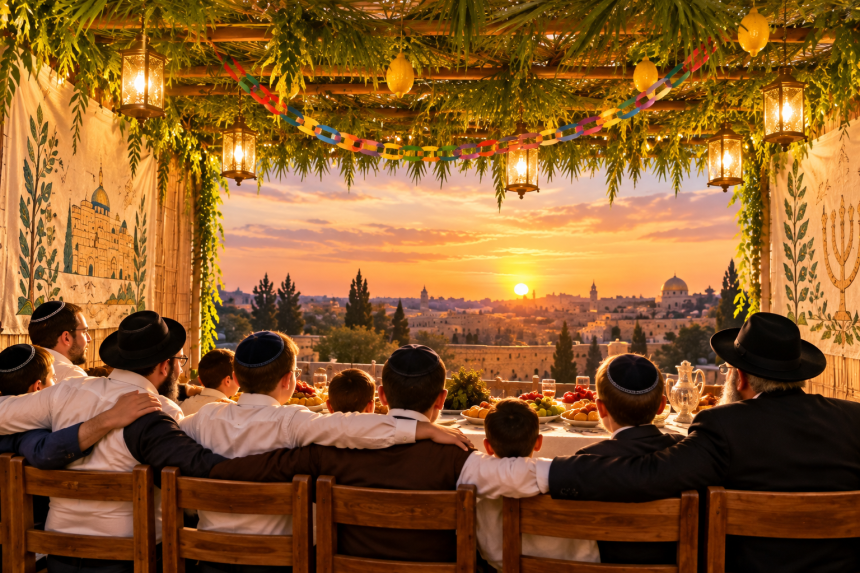
On Yom Kippur, as our sins are forgiven, Klal Yisrael can once again become one. The Sfas Emes explains that this is why we merited receiving the second Luchos on Yom Kippur. The sin of the Golden Calf had damaged our unity, but through forgiveness that unity was restored, preparing us to receive the Torah once again. With this renewed closeness to Hashem and to one another, we can then enter Sukkos together—a Yom Tov with a particularly powerful message of unity.
This message of unity should accompany us throughout Sukkos. There are many beautiful hiddurim and stringencies through which we can strive to perform the mitzvos of Sukkos in the finest possible way. Yet, at the same time, we must never lose sight of the special spirit of these days—a time when Klal Yisrael comes together as one.
Part of preserving that unity is being sensitive to the feelings of those around us. Even when we are striving for the highest standards in our own mitzvah observance, we should be careful that this never creates distance between ourselves and another Jew.
Sukkos reminds us that alongside our desire to beautify each mitzvah, we should cherish the precious bond that connects every member of Klal Yisrael. Sometimes, a little thoughtfulness, understanding and sensitivity can help preserve that sense of togetherness.
Rav Yankele of Pshevorsk was a revered Chassidic Rebbe who led the Pshevorsk community in Antwerp. His life had taken him through extraordinarily difficult times. During the war years, he suffered imprisonment and forced labor in Siberia, where even under the harshest conditions he remained deeply devoted to the mitzvos. That same devotion remained with him throughout his life.
Many years later, during Chol HaMo’eid Sukkos, the Rebbe went to visit an elderly Chasid who lived with his wife on a high floor of an assisted-living facility. His declining health had made it very difficult for him to leave the apartment.
When the Rebbe arrived, the Chasid’s wife quietly asked him for a favor. “Please, Rebbe, don’t tell him that it is Sukkos. If he knows, he will insist on going downstairs to the Succah, and it is simply too difficult for him.” The Rebbe agreed and entered without revealing the reason for the visit.
The Chasid was overjoyed to see the Rebbe. After warmly greeting him, he immediately turned to his wife and asked her to bring the Rebbe some fruit. Soon, a beautiful platter was brought into the room. The Chasid then turned to the Rebbe with another request: “Please make a brachah on a fruit. It would be a great zechus for me.”
The Rebbe was now faced with a difficult dilemma. Throughout his life, he had been extremely careful never to eat or drink outside the Succah during Sukkos. This was no ordinary stringency for him. Even during those challenging years in Siberia, he had refused to give it up. In the bitter conditions of the labor camp, he would preserve his meager food until he could enter a tiny makeshift Succah that he had fashioned in a pit in the frozen ground and covered with twigs.
The Rebbe took an apple and began peeling it. He passed it from one hand to the other while continuing to speak with the Chasid, hoping to postpone the moment. The elderly man, however, continued waiting patiently and then pleaded, “Please, Rebbe. I need the Zechus of your Brachah.”
Finally, the Rebbe took a very small piece of the apple, which was Halachically permissible, and recited the Brachah aloud. The Chasid immediately responded with a powerful “Amen!”
Afterward, the Rebbe’s attendant asked him how he could have eaten outside the Succah when even the hardships of Siberia had not caused him to compromise on this practice. The Rebbe replied, “In Siberia, I was willing to sacrifice myself for the Mitzvah of Succah. Yet, to sacrifice another Yid? That I simply cannot do.”
The Rebbe understood that there are times when one must be willing to give up even a cherished stringency for the sake of another Jew. His Mesiras Nefesh was not only for the Mitzvah of Succah; it was also for the dignity and feelings of a fellow Jew.
[1] Sfas Emes, Yom Kippur 5651