

At the end of our parasha we read of how Amalek attacked the Bnei Yisrael as they came out of Egypt (Devarim 25:18)
how he surprised you on the way and cut off all the stragglers at your rear, when you were faint and weary, and he did not fear G-d
Who was it that didn’t fear Hashem? It seems, at first sight, that it was definitely Amalek, but the Torah is sufficiently ambiguous for Rashi to have to tell us that indeed it was Amalek.
The Torah emphasises how Amalek attacked the stragglers, the weakest amongst the Bnei Yisrael. But why did the Torah go out of its way to tell us that Amalek targeted the weak – not something we particularly need to know? And why tell us that Amalek wasn’t G-d fearing? Neither of these details are mentioned in the account at the end of Beshallach – so why does the Torah relate these facts here, in the second account of the Amalek story?
The Daat Zekenim tells us that actually it wasn’t Amalek that the Torah refers to in saying that he didn’t fear Hashem. It was the Bnei Yisrael that didn’t fear Hashem. How so? By cheating with weights – and note that the Torah juxtaposes the warning about having false weights in one’s house, to the parasha of Amalek.
Chizkuni also says that it wasn’t Amalek that the pasuk refers to as not fearing Hashem – he says that these words were said by Moshe to the Bnei Yisrael – he tells them that if they had properly observed the commandments that they already knew about, Amalek could not have done them any harm.
So, in being deliberately ambiguous, the Torah is giving us two messages. Firstly, that Amalek who for sure was not a G-d fearing nation attacked our weakest members of society – that’s the sort of behaviour that comes easily to a people that isn’t G-d fearing. Secondly that Hashem protects the Bnei Yisrael when they are G-d fearing, but when not G-d fearing they are susceptible to harm. If we must be G-d fearing, how should we conduct ourselves? I don’t think we could find a better example to follow than the prophet Ovadiah. Uniquely in Tanach, he is given the accolade of being very G-d fearing (I Kings 18:3) in recognition of having protected and fed a hundred prophets who were being persecuted by Ahab’s wife, Jezebel. We too, should do all we can to protect the weakest in society. We have a responsibility to look after those marginalised by society, and those not able to look after themselves.
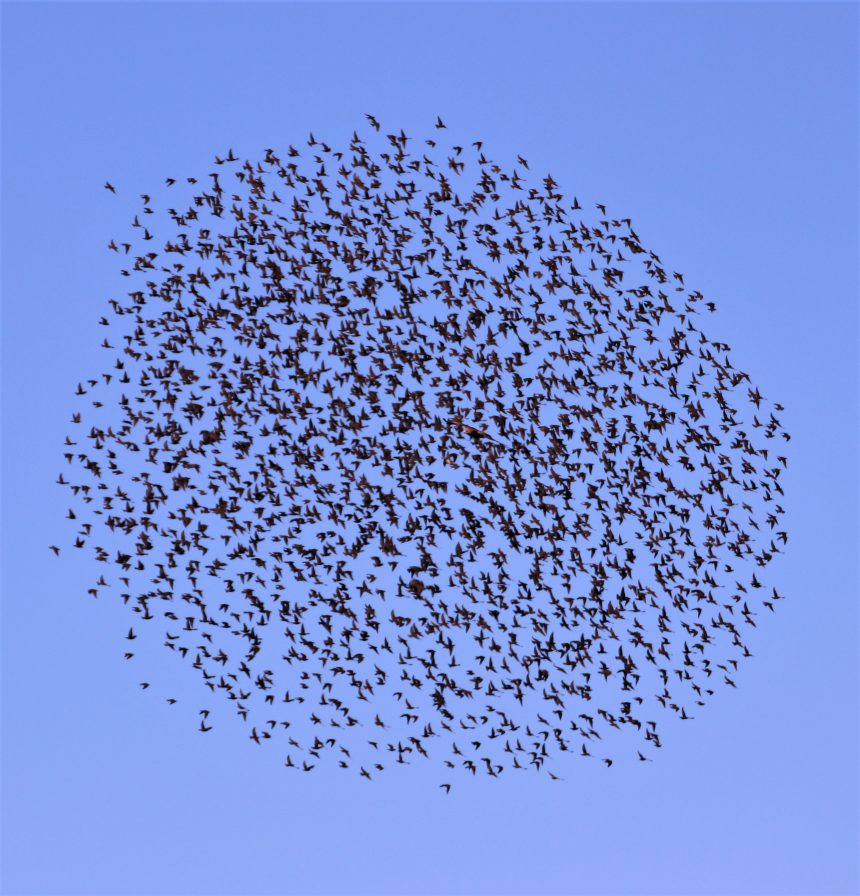
I was lucky enough to see thousands of starlings flying in a murmuration, near Bet She’an in Israel, on a cold December day last year. It was truly mesmerising to watch them twisting and turning, swooping and swirling, with everchanging patterns. And flying amongst them were several large black kites, each of whom would have welcomed a starling lunch. But by staying close to each other, the starlings were able to share their warmth and with their ducking and diving they were able to confuse their predators. Working together as one big community, the weakest amongst them were no more under threat than the strongest. The starlings stayed safe, and the black kites were left hungry.
Let’s make sure that, like the starlings, we care for the sick and the lonely; let’s make sure we include in our society, widows, orphans and divorcees; let’s make sure that we’re truly G-d fearing and honest in all our dealings; then we can hope that Hashem will protect us from our predators – all of us, not just those who can take care of themselves[1].
[Photo of mesmerising murmuration taken by Julian Alper]
[1] The first instruction to us to have honest weights and measures (Vayikra 19:35-36) immediately follows a pasuk about looking after strangers. The stranger who sojourns with you shall be as a native from among you, and you shall love him as yourself; for you were strangers in the land of Egypt. I am Hashem, your G-d.