Avraham was privileged to have Hashem reveal Himself to him. As we see in the opening of our parashah, Hashem appeared to him, telling him to leave his land. Yet, there is so much that happened before this that built up to this precious moment. After all, Avraham was raised in a society where idol worship was rampant. No one ever spoke of Hashem; instead, they worshipped wood and stone images. His father, Terach, ran an idol store, and idolatry was something that he grew up with and was constantly exposed to. It is therefore incredible how he was able to see past these falsehoods and discover Hashem of his own accord, resulting in Hashem appearing to him. What exactly led him to do this?
The Rambam (Avodah Zarah 1:3) explains that ever since Avraham was a young child, he was mesmerized by the incredible world and used to contemplate it day and night. He would ask: “How does the universe go round? Who is moving it? It can’t just go around by itself.” Through asking these questions and contemplating, Avraham came to the realization that the world had to have a G-d, and his idol-worshipping peers were completely mistaken.
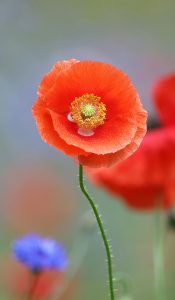
This eventually brought Hashem to reveal Himself to him, and the Jewish nation was formed. We were chosen to be Hashem’s emissaries on this earth, all in the merit of our ancestor Avraham, who appreciated the world’s incredible natural beauty. We should strive to follow in his legacy and be awed by the stunning natural world around us. We could ask ourselves the same questions as Avraham: Look at the beautiful hills, the luscious green grass, the attractive flowers, the wonders of the human body, etc. Hashem truly created such a magnificent world!
The Alter of Kelm explains that this helps us understand why the first berachah of the Shmoneh Esrei discusses the Avot. The goal of the first three berachot is to praise Hashem, so why is it necessary to mention the G-d of Avraham, Yitzchak, and Yaakov? The Avot were privileged to have a relationship with Hashem, before the Torah was given, by contemplating and appreciating all He does. Therefore, we mention them in order to arouse ourselves to follow in their footsteps and appreciate all Hashem does to the best of our ability. (Chochmah U’Mussar 1:129)
The Rambam (Yesodei HaTorah 2:2) writes that this approach is the ideal way for us to come to love and fear Hashem:
“How does one come to love and fear Hashem? When one contemplates His handiwork and His phenomenal creations, he will observe wisdom which has no bounds; immediately he will love and praise Him with such intense longing…”
One might think appreciating the incredible world is just a good practice, yet the Chovot HaLevavot (Sha’ar HaBechinah, Hakdamah) teaches that this is actually an obligation. He cites numerous sources from Scripture and Chazal to support this. He then goes into great detail about the extent of the obligation and what it is incumbent upon us to contemplate.
For example, the wonders of the human body—the gift of eyesight, hearing, freedom of movement, digestion, blood circulation, etc. The miracle of food production and how every species obtains all the sustenance they need. The incredible benefits we gain from the sun—an abundance of light and energy. The fascinating phenomena of childbirth, memory, the ability to talk, write, etc. These are just a few of the examples quoted in Sha’ar HaBechinah regarding our obligation to contemplate Hashem’s spectacular phenomena. He writes that “the most direct way to obtain a clear understanding of Hashem’s presence is by examining the wisdom in Hashem’s creations.” (Sha’ar HaBechinah, Hakdamah)
May we be zocheh to follow in Avraham’s footsteps and appreciate Hashem’s spectacular world.
A girl with little Jewish background was on vacation in Hawaii with her family. She observed the powerful movements of the waves and how they constantly crashed on the seashore. This led her to the realization that the natural world is so profound, and there is so much that she didn’t understand and took for granted, encouraging her to resolve to pay more attention to the beautiful world around her. During a hike with her family, she witnessed some beautiful bamboo shoots whose bark was elegantly covered in gold and green vertical stripes. She wondered if someone had painted these, but when looking above her, her doubt was resolved. She saw these shoots tower above her, over fifty feet high, with the elegant stripes running all the way to the top. “G-d has quite a paintbrush,” she expressed with bewilderment. Observing these incredible natural phenomena cleared all the doubts she had been feeling about G-d and led her to a very deep belief that the world had to have a Creator. When she returned home, she resolved to study more about Judaism, eventually becoming a fully observant Jew—all due to observing the beautiful natural world. (Like Water on a Rock, p. 2)